
Org. Hierarchy
Global standards flow down. Local autonomy stays protected.

RBAC
No one acts beyond their authority. No exceptions.

Data Sovereignty
EU, North America, or Asia-Pacific — your data, your choice.

Asset Utilization
Your compliance capacity, visible and scalable at any time.

Audit Log
Configuration is never a blind spot. Every change is tracked.
Multi-Entity & Organizational
Hierarchy
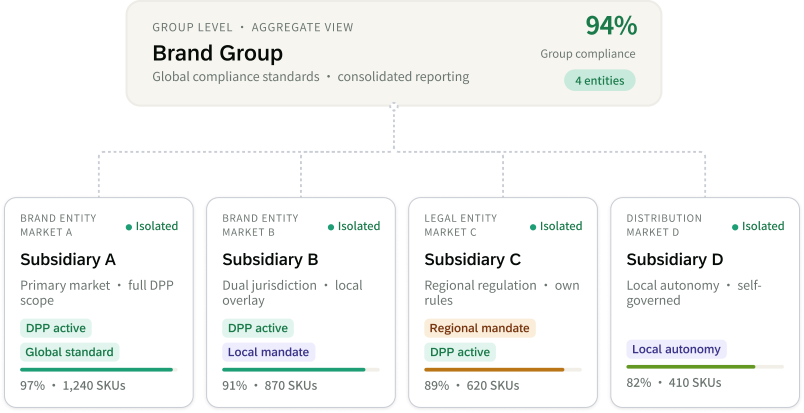
One Platform. Clear Jurisdictional Boundaries
Large organizations operate across brands, legal entities, and regions. Settings allows you to define precise organizational structures: aggregate compliance data at the group level while maintaining strict operational isolation for individual subsidiaries. Set global standards that flow down, or allow regional autonomy where local mandates differ.
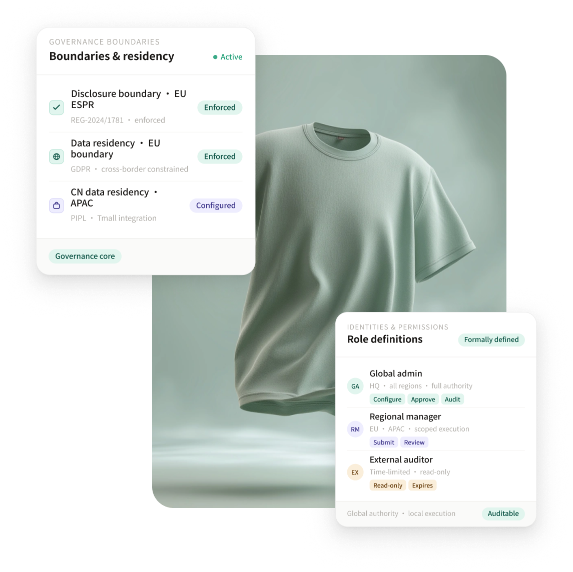
Identity & Access Governance (RBAC)
Who can act — and under what authority
Passloom enforces strict Role-Based Access Control aligned with enterprise functions. Define the separation of duties between data submission, approval, and public disclosure. With granular, field-level permissions, every action - from SKU configuration to a new disclosure - is performed by a verified identity under explicit authority.
Data Sovereignty & Residency
Compliant storage for a global footprint
Passloom provides flexible data residency options - choose where your sensitive compliance evidence is stored (e.g. North America, Europe, Pacific). Manage cross-border data transfers and data residency requirements with ease, ensuring compliance with strict, local, and regional data sovereignty mandates.
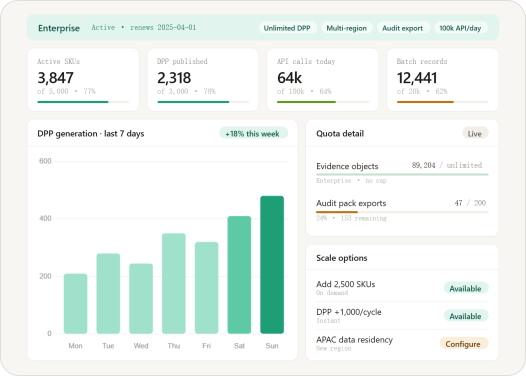
Subscription & Asset Utilization
MEASURING YOUR COMPLIANCE CAPACITY
Manage your compliance infrastructure as a strategic asset. Monitor your current tier, SKU quotas, and DPP generation limits in real-time. Settings provides full transparency into your system utilization, allowing you to scale your capacity as your product portfolio and market reach expand.
Configuration Audit Log
Measuring your compliance capacity
In Passloom, configuration is never a blind spot. Every change to settings, permissions, or rule activations is logged, timestamped, and attributed to a responsible owner. We record the justification for every administrative action, ensuring that the system's "source of truth" remains undefiled and fully reconstructible during an audit.
.Czl6ZXX8.svg)